• Link to Instagram
  • Link to Facebook
  • Link to Youtube
  • Sign Up For Our Newsletter And Get A Free Foraging Guide!
Found Food
  • Home
  • Foraging Books
    • The Wild Mixologist: Cocktails & Mocktails
    • The Bushcrafter’s Guide to Foraging
    • UK Seasonal Foraging Books
    • The Forager’s Introduction to Botany
  • Online Courses
    • Getting Started Foraging for Wild Food
    • Wild Food & ID Masterclass
    • Wild Cocktails Course
  • Book Foraging Experiences
  • About
    • FAQs
    • The Association of Foragers
    • Testimonials
    • Blog
  • Contact Us
  • Click to open the search input field Click to open the search input field Search
  • Menu Menu

Yew liqueur, you!

2017, Berries, Foraging, October, Recipe, Tree

So, we all know (or should know) that every part of the Yew tree is highly toxic to humans. When I say highly toxic, what I mean is that a very small amount can kill you. All parts contain taxin, a complex of alkaloids which are rapidly absorbed.

If you are poisoned by it, sometimes there are no symptoms, followed by death within a few hours. Where there are symptoms, they include trembling, staggering, coldness, weak pulse and collapse.

So what’s the good news?

Now that I’ve scared the living daylights out of you, there is one part that is not toxic. See those pretty little red berries, the red flesh is not toxic, and is also quite nice and sweet tasting; However, the hard, dark-coloured seeds inside, have probably the highest concentration of toxins of the whole tree. It is said that if unbroken, the seeds will pass through you without being digested and without causing harm.

I’m not sure it’s worth the risk, personally. However, I have been known to pick a few and spit the seeds out. The flesh is really quite nice (although I have heard some people compare the texture to snot – but I couldn’t possibly comment).

I’m assuming that it’s for for safety’s sake that there are no recipes for yew berry flesh, or even many instructions to tell you the safe way of eating them. After all, I could easily imagine someone seeing other people eating them and assuming that they’re completely safe, followed shortly afterwards by a trip to the hospital, or the morgue!

Time to make some yew liqueurs

That said, I decided that I would have a play with the flavours and some spirits to see if anything gave good results. Maybe some kind of yew liqueur?

The first step is to separate the flesh from the poisonous seeds. I tried to freeze them first to make it easier, but they didn’t freeze very well, so it was a quite disgusting manual job. The squeezed flesh went quite sticky.
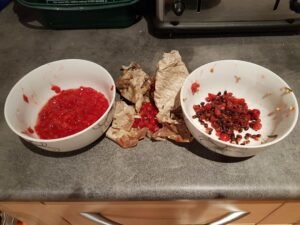
So finally, I split the berry flesh into three portions and put them into some clean, sterilized Kilner-type jars. Over each, I then poured filtered white rum, filtered gin, and filtered vodka. Then I left them to sit and infuse (hopefully), giving them a helpful little shake each time I passed by.
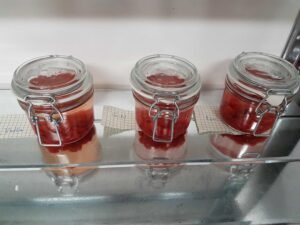
The results…

So, after infusing for 2 weeks now, so it was time for a little try. At this point, the spirits had started to sweeten slightly, but not much change to colour or flavour.

After 4 weeks, things had moved on somewhat, so I strained and bottled the infusions.
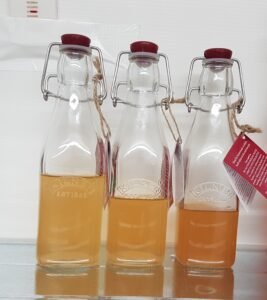
White rum, vodka and gin yew infusions

Now you can see that not only have they taken on slightly different colours across the different spirits, but also I’ve ended up with slightly different amounts of end product, despite the fact that they started with the same volume of berries and spirits.

The judgement

First of all, they are all quite nice. The berries have imparted a slight sweetness, some of their stickiness has come through and made the spirits thicker and smoother, and there’s a very subtle citrus berry flavour.

However, one stands out above the rest. The Gin infusion seems to have worked very well. It’s nice to drink on its own, and if we hadn’t drunk it all it would probably go quite well in a cocktail. Maybe I’ll make it again this year, but try to save some for cocktail experiments, or make some more!
Share this:

  • Share on Facebook (Opens in new window) Facebook
  • Share on X (Opens in new window) X

Like this:

Like Loading…

Related

5 October 2018/1 Comment/by Gavin
Tags: alcohol-infusions, blog, foraging, FoundFood, poisonous, yew, yew liqueur, yew-berries
Share this entry
  • Share on Facebook
  • Share on X
  • Share on WhatsApp
  • Share on LinkedIn
  • Share by Mail
https://foundfood.com/wp-content/uploads/2021/03/20181018_131148-scaled.jpg 2560 1920 Gavin https://foundfood.com/wp-content/uploads/2024/05/Found_Food_Foraging_newlogo-300x158.png Gavin2018-10-05 09:25:362023-12-07 12:00:14Yew liqueur, you!
You might also like
London Plane Tree (Platanus × acerifolia)
3 Things You Can Forage For In August
Foraging on the Coastline – Part 1
A Video about Crow Garlic
Lime or Linden Tree Flowers – Tilia x europea
3 Things You Can Forage For In October
Foraging the Edges of Epping Forest in Winter
The Parts of a Flower
1 reply

Trackbacks & Pingbacks

  1. 32 Plants That Have Been Sacred Through The Ages And How To Grow Them says:
    22 February 2025 at 8:01 pm

    […] © Found Food […]

    Reply

Leave a Reply

Want to join the discussion?
Feel free to contribute!

Leave a Reply Cancel reply

Your email address will not be published. Required fields are marked *

Search Search

Categories

  • 2017
  • 2018
  • 2024
  • 2025
  • Aegopodium podograria
  • Alliaria petiolata
  • Allium
  • Allium ursinum
  • Allium vineale
  • Allium vineale
  • April
  • Artemisia vulgaris
  • Asteraceae
  • August
  • Auricularia auricula-judae
  • Autumn
  • Ballota nigra
  • Berries
  • Boletus edulis
  • Calocybe gambosa
  • Cardamine hirsuta
  • Castanea sativa
  • Chamaenerion
  • Chamaenerion
  • Chamaenerion angustifolium
  • Cirsium vulgare
  • Coastal
  • Conopodium
  • Conopodium majus
  • Coprinus comatus
  • Crataegus
  • Crataegus monogyna
  • February
  • Flowers
  • Foraging
  • Fragaria vesca
  • Fungus
  • General
  • Geranium molle
  • Glechoma
  • Glechoma hederacea
  • Grifola frondosa
  • Inula helenium
  • January
  • June
  • Juniperus
  • Lamium album
  • Lamium purpureum
  • Larix
  • Larix decidua
  • Larix larcina
  • Lavandula
  • Leaves
  • Mahonia aquifolium
  • March
  • Medicine
  • Melissa
  • Melissa officinalis
  • October
  • Onagraceae
  • Picea
  • Picea abies
  • Picea glauca
  • Picea sitchensis
  • Pinus contorta
  • Pinus strobus
  • Plants
  • Platanus x acerifolia
  • Prunella
  • Prunella vulgaris
  • Prunus
  • Prunus spinosa
  • Rabelera
  • Recipe
  • Reynoutria
  • Reynoutria japonica
  • Ribes
  • Ribes rubrum
  • Roots
  • Rosa canina
  • Rosaceae
  • Rumex acetosa
  • Rumex crispus
  • Sambucus nigra
  • Sarcoscypha coccinea
  • Sequoia
  • Sequoia sempervirens
  • Sequoiadendron
  • Silene
  • Silene dioica
  • Smyrnium olusatrum
  • Solanum
  • Solanum americanum
  • Spring
  • Stachys
  • Stachys sylvatica
  • Stellaria
  • Stellaria media
  • Stellaria nemorum
  • Summer
  • Survival
  • Symphytum officinale
  • Symphytum x uplandicum
  • Taraxacum
  • Taraxacum officinale
  • Thuja occidentalis
  • Thuja plicata
  • Tilia
  • Tilia cordata
  • Tree
  • Tsuga
  • Tsuga canadensis
  • Tsuga heterophylla
  • Tussilago farfara
  • Typha angustifolia
  • Typha latifolia
  • Uncategorised
  • Urtica dioica
  • Urticaceae
  • Video
  • wildlife
  • Winter
Privacy & Cookies: This site uses cookies. By continuing to use this website, you agree to their use.

To find out more, including how to control cookies, see here: Cookie Policy

FoundFood

  • Home
  • Contact
  • About

Helper Sites

  • The Forager Helper
  • The Wild Herbalist Helper (coming soon…)

Courses and Walks

    • Face-to-face experiences
    • Private events
    • Online Courses
    • FREE Weekly Foraging Zoom Calls


Publications

    • Publications
    • Newsletter


Trustpilot
© Copyright - Found Food
  • Link to Instagram
  • Link to Facebook
  • Link to Youtube
  • Terms of Service
  • Privacy Policy
Link to: Wild Carrots Link to: Wild Carrots Wild Carrots Link to: A Forager’s Visit to Corfu Link to: A Forager’s Visit to Corfu A Forager’s Visit to Corfu
Scroll to top Scroll to top Scroll to top

This site uses cookies. By continuing to browse the site, you are agreeing to our use of cookies.

Accept settingsHide notification onlySettings

Cookie and Privacy Settings


How we use cookies

We may request cookies to be set on your device. We use cookies to let us know when you visit our websites, how you interact with us, to enrich your user experience, and to customize your relationship with our website.

Click on the different category headings to find out more. You can also change some of your preferences. Note that blocking some types of cookies may impact your experience on our websites and the services we are able to offer.

Essential Website Cookies

These cookies are strictly necessary to provide you with services available through our website and to use some of its features.

Because these cookies are strictly necessary to deliver the website, refusing them will have impact how our site functions. You always can block or delete cookies by changing your browser settings and force blocking all cookies on this website. But this will always prompt you to accept/refuse cookies when revisiting our site.

We fully respect if you want to refuse cookies but to avoid asking you again and again kindly allow us to store a cookie for that. You are free to opt out any time or opt in for other cookies to get a better experience. If you refuse cookies we will remove all set cookies in our domain.

We provide you with a list of stored cookies on your computer in our domain so you can check what we stored. Due to security reasons we are not able to show or modify cookies from other domains. You can check these in your browser security settings.

Other external services

We also use different external services like Google Webfonts, Google Maps, and external Video providers. Since these providers may collect personal data like your IP address we allow you to block them here. Please be aware that this might heavily reduce the functionality and appearance of our site. Changes will take effect once you reload the page.

Google Webfont Settings:

Google Map Settings:

Google reCaptcha Settings:

Vimeo and Youtube video embeds:

Privacy Policy

You can read about our cookies and privacy settings in detail on our Privacy Policy Page.

Privacy Policy
Accept settingsHide notification only

Loading Comments...

    %d