• Link to Instagram
  • Link to Facebook
  • Link to Youtube
  • Sign Up For Our Newsletter And Get A Free Foraging Guide!
Found Food
  • Home
  • Foraging Books
    • The Wild Mixologist: Cocktails & Mocktails
    • The Bushcrafter’s Guide to Foraging
    • UK Seasonal Foraging Books
    • The Forager’s Introduction to Botany
  • Online Courses
    • Getting Started Foraging for Wild Food
    • Wild Food & ID Masterclass
    • Wild Cocktails Course
  • Book Foraging Experiences
  • About
    • FAQs
    • The Association of Foragers
    • Testimonials
    • Blog
  • Contact Us
  • Click to open the search input field Click to open the search input field Search
  • Menu Menu

Tag Archive for: vein

Structure and Parts of a Leaf

2017, April, Foraging, Leaves

No seriously! It’s more complex than you might imagine, and having a common language really helps when talking about the parts of a leaf.

For the avoidance of doubt, leaf refers to both the flat type that you imagine, and the needles and scales found on some evergreens. This is not a complete reference, just the parts that I find most useful.

You’d better get comfortable, this is a long post…

Simple Parts of a Leaf
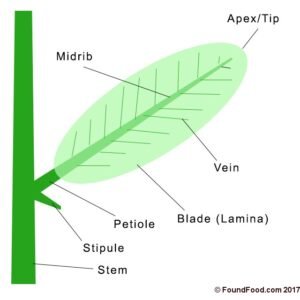
Parts of a leaf diagram

This is a simplified, generalisation. There are, of course, exceptions and variations. The leaf Blade, attaches to the stem of the plant with it’s Petiole. Quite often you will find a Stipule at the base of the petiole, which is like a miniature leaf arrangement. Within the leaf, there will be at least one strengthening midrib, and veins running from it. The leaf receives water and returns sugars through these.

Identification Categories

When it comes to identifying plants by their leaves, there are a number of areas to consider:

  1. The arrangement of the leaves on the stem.
  2. Simple vs Compound Leaves.
  3. Characteristics of the petiole.
  4. Veins.

1. Arrangement

The arrangement of the leaves on the stem can provide vital clues to the identification of a plant. Indeed, for some plants, it’s even in the name. For example, Opposite-leaved, Golden Saxifrage.

These are the main arrangements you may encounter:

  • Opposite – Two leaves from the same point at each point or node on the stem, growing in opposite directions.
  • Alternate – One leaf attached at each point or node on the stem, each successive leaf growing in opposite directions.
  • Basal – Arising from the base of the stem.
  • Cauline – Arising from the Aerial stem.
  • Whorled or Verticillate – Three or more leaves from the same point or node.
  • Rosulate – The leaves form a rosette.
  • Distichous – Leaves are attached in two rows. They can be either opposite or alternate in arrangement.

As a stem grows, leaves tend to grow in the optimum position for collecting light. This can result in leaves forming a helical pattern around the stem.

2. Simple vs Compound Leaves

So, a leaf is a leaf, right? Well, not exactly. There are simple leaves, and leaves which are made up of leaflets. In deciduous trees, for example, the part which detaches itself from the tree in Autumn (Fall) is a leaf. So in Oak trees, that’s a simple Oak leaf, whereas in Ash trees, it’s a compound leaf with multiple leaflets (see images# below).

A simple leaf may be deeply lobed, but as long as gaps do not reach the midrib, it is still a simple leaf. Each leaflet of a compound leaf may have it’s own Petiolule (equivalent of a Petiole) and Stipule (Stipel).

Types of Compound Leaf

  • Palmately Compound – Leaflets radiate from the end of the Petiole, like the fingers of a hand e.g. Horse Chestnut
  • Pinnately Compound – Leaflets are arranged along the main or mid-vein.
    • Odd Pinnate – With a terminal leaflet e.g. Ash.
    • Even Pinnate – Without a terminal leaflet e.g. Mahogany.
  • Bipinnately Compound – The leaves are twice divided. The leaf has a main vein, and further secondary veins on which the leaflets are attached e.g. Silk Tree.
  • Trifoliate – A pinnate leaf with just three leaflets e.g. Clover.

3. Characteristics of the Petiole

Leaves with a stalk (petiole) are said to be petiolate. Those without a stalk, which join straight to the branch are said to be sessile.

Where the blade of a leaf partially surrounds the stem, it is said to be clasping or decurrent. Where the blade completely surrounds the stem they are called perfoliate.

The stipule, where present, is a leaf-like appendage on each side at the base of the petiole. Stipules may remain (such as on roses) or be shed as the leaf expands, leaving scars; Known as stipulations.

4. Veins

Veins, occasionally referred to as nerves, extend into the leaf via the petiole and transport nutrients and water between the leaf and the stem. They also play a mechanical role in supporting the leaf structure. Branching from the main vein are secondary veins, and there can be many more branchings, sometimes leading to a net-like structure.

Leaf Shape Terminology

ImageNameDescription
 Auriculate Having ear-shaped appendages near the petiole e.g. Arum Maculatum
 Cordate Heart-shaped, with the petiole or stem attached to the notch.
 Deltoid Shaped like Greek letter Delta, triangular, stem attaches to side.
 Digitate With finger-like lobes, similar to palmate.
 Elliptic Oval, with a short or no point.
 Hastate Spear-shaped: Pointed, with barbs, shaped like a spear point, with flaring pointed lobes at the base.
 Lanceolate Long, wider in the middle, shaped like a lance tip.
 Linear Long and very narrow like a blade of grass.
 Lobed Being divided by clefts, may be pinnately lobed or palmately lobed.
 Obcordate Heart-shaped, stem attaches at the tapering end.
 Oblique Asymmetrical leaf base, with one side lower than the other.
 Oblong Having an elongated form with slightly parallel sides, roughly rectangular.
 Obovate Teardrop-shaped, stem attaches to the tapering end; reversed ovate.
 Ovate Oval, egg-shaped, with a tapering point and the widest portion near the petiole.
 Palmate Palm-shaped, i.e. with lobes or leaflets stemming from the leaf base.
 Perfiolate With the leaf blade surrounding the stem such that the stem appears to pass through the leaf.

Leaf Edge Terminology

 Entire Even; with a smooth margin; without toothing.
 Ciliate Fringed with hairs.
 Crenate Wavy-toothed; dentate with rounded teeth.
 Lobate Indented, with the indentations not reaching the center.
 Serrate Saw-toothed; with asymmetrical teeth pointing forward.
 Doubly-Serrate Each tooth bearing smaller teeth.

Source: Wikipedia

More information…

Did you find this useful?

You can find more useful botanical information in our new book, The Forager’s Introduction to Botany here: https://shop.foundfood.com/products/the-foragers-guide-to-botany

Or, sign up to our email newsletter

28 April 2017/0 Comments/by Gavin
https://foundfood.com/wp-content/uploads/2021/03/LeafPartsC.jpg 640 640 Gavin https://foundfood.com/wp-content/uploads/2024/05/Found_Food_Foraging_newlogo-300x158.png Gavin2017-04-28 14:23:242024-03-12 11:33:25Structure and Parts of a Leaf
Search Search

Categories

  • 2017
  • 2018
  • 2024
  • 2025
  • Aegopodium podograria
  • Alliaria petiolata
  • Allium
  • Allium ursinum
  • Allium vineale
  • Allium vineale
  • April
  • Artemisia vulgaris
  • Asteraceae
  • August
  • Auricularia auricula-judae
  • Autumn
  • Ballota nigra
  • Berries
  • Boletus edulis
  • Calocybe gambosa
  • Cardamine hirsuta
  • Castanea sativa
  • Chamaenerion
  • Chamaenerion
  • Chamaenerion angustifolium
  • Cirsium vulgare
  • Coastal
  • Conopodium
  • Conopodium majus
  • Coprinus comatus
  • Crataegus
  • Crataegus monogyna
  • February
  • Flowers
  • Foraging
  • Fragaria vesca
  • Fungus
  • General
  • Geranium molle
  • Glechoma
  • Glechoma hederacea
  • Grifola frondosa
  • Inula helenium
  • January
  • June
  • Juniperus
  • Lamium album
  • Lamium purpureum
  • Larix
  • Larix decidua
  • Larix larcina
  • Lavandula
  • Leaves
  • Mahonia aquifolium
  • March
  • Medicine
  • Melissa
  • Melissa officinalis
  • October
  • Onagraceae
  • Picea
  • Picea abies
  • Picea glauca
  • Picea sitchensis
  • Pinus contorta
  • Pinus strobus
  • Plants
  • Platanus x acerifolia
  • Prunella
  • Prunella vulgaris
  • Prunus
  • Prunus spinosa
  • Rabelera
  • Recipe
  • Reynoutria
  • Reynoutria japonica
  • Ribes
  • Ribes rubrum
  • Roots
  • Rosa canina
  • Rosaceae
  • Rumex acetosa
  • Rumex crispus
  • Sambucus nigra
  • Sarcoscypha coccinea
  • Sequoia
  • Sequoia sempervirens
  • Sequoiadendron
  • Silene
  • Silene dioica
  • Smyrnium olusatrum
  • Solanum
  • Solanum americanum
  • Spring
  • Stachys
  • Stachys sylvatica
  • Stellaria
  • Stellaria media
  • Stellaria nemorum
  • Summer
  • Survival
  • Symphytum officinale
  • Symphytum x uplandicum
  • Taraxacum
  • Taraxacum officinale
  • Thuja occidentalis
  • Thuja plicata
  • Tilia
  • Tilia cordata
  • Tree
  • Tsuga
  • Tsuga canadensis
  • Tsuga heterophylla
  • Tussilago farfara
  • Typha angustifolia
  • Typha latifolia
  • Uncategorised
  • Urtica dioica
  • Urticaceae
  • Video
  • wildlife
  • Winter
Privacy & Cookies: This site uses cookies. By continuing to use this website, you agree to their use.

To find out more, including how to control cookies, see here: Cookie Policy

FoundFood

  • Home
  • Contact
  • About

Helper Sites

  • The Forager Helper
  • The Wild Herbalist Helper (coming soon…)

Courses and Walks

    • Face-to-face experiences
    • Private events
    • Online Courses
    • FREE Weekly Foraging Zoom Calls


Publications

    • Publications
    • Newsletter


Trustpilot
© Copyright - Found Food
  • Link to Instagram
  • Link to Facebook
  • Link to Youtube
  • Terms of Service
  • Privacy Policy
Scroll to top Scroll to top Scroll to top

This site uses cookies. By continuing to browse the site, you are agreeing to our use of cookies.

Accept settingsHide notification onlySettings

Cookie and Privacy Settings


How we use cookies

We may request cookies to be set on your device. We use cookies to let us know when you visit our websites, how you interact with us, to enrich your user experience, and to customize your relationship with our website.

Click on the different category headings to find out more. You can also change some of your preferences. Note that blocking some types of cookies may impact your experience on our websites and the services we are able to offer.

Essential Website Cookies

These cookies are strictly necessary to provide you with services available through our website and to use some of its features.

Because these cookies are strictly necessary to deliver the website, refusing them will have impact how our site functions. You always can block or delete cookies by changing your browser settings and force blocking all cookies on this website. But this will always prompt you to accept/refuse cookies when revisiting our site.

We fully respect if you want to refuse cookies but to avoid asking you again and again kindly allow us to store a cookie for that. You are free to opt out any time or opt in for other cookies to get a better experience. If you refuse cookies we will remove all set cookies in our domain.

We provide you with a list of stored cookies on your computer in our domain so you can check what we stored. Due to security reasons we are not able to show or modify cookies from other domains. You can check these in your browser security settings.

Other external services

We also use different external services like Google Webfonts, Google Maps, and external Video providers. Since these providers may collect personal data like your IP address we allow you to block them here. Please be aware that this might heavily reduce the functionality and appearance of our site. Changes will take effect once you reload the page.

Google Webfont Settings:

Google Map Settings:

Google reCaptcha Settings:

Vimeo and Youtube video embeds:

Privacy Policy

You can read about our cookies and privacy settings in detail on our Privacy Policy Page.

Privacy Policy
Accept settingsHide notification only

Loading Comments...